SmartLink
2022 - Current | Product Designer | Weathermatic
Problem Statement
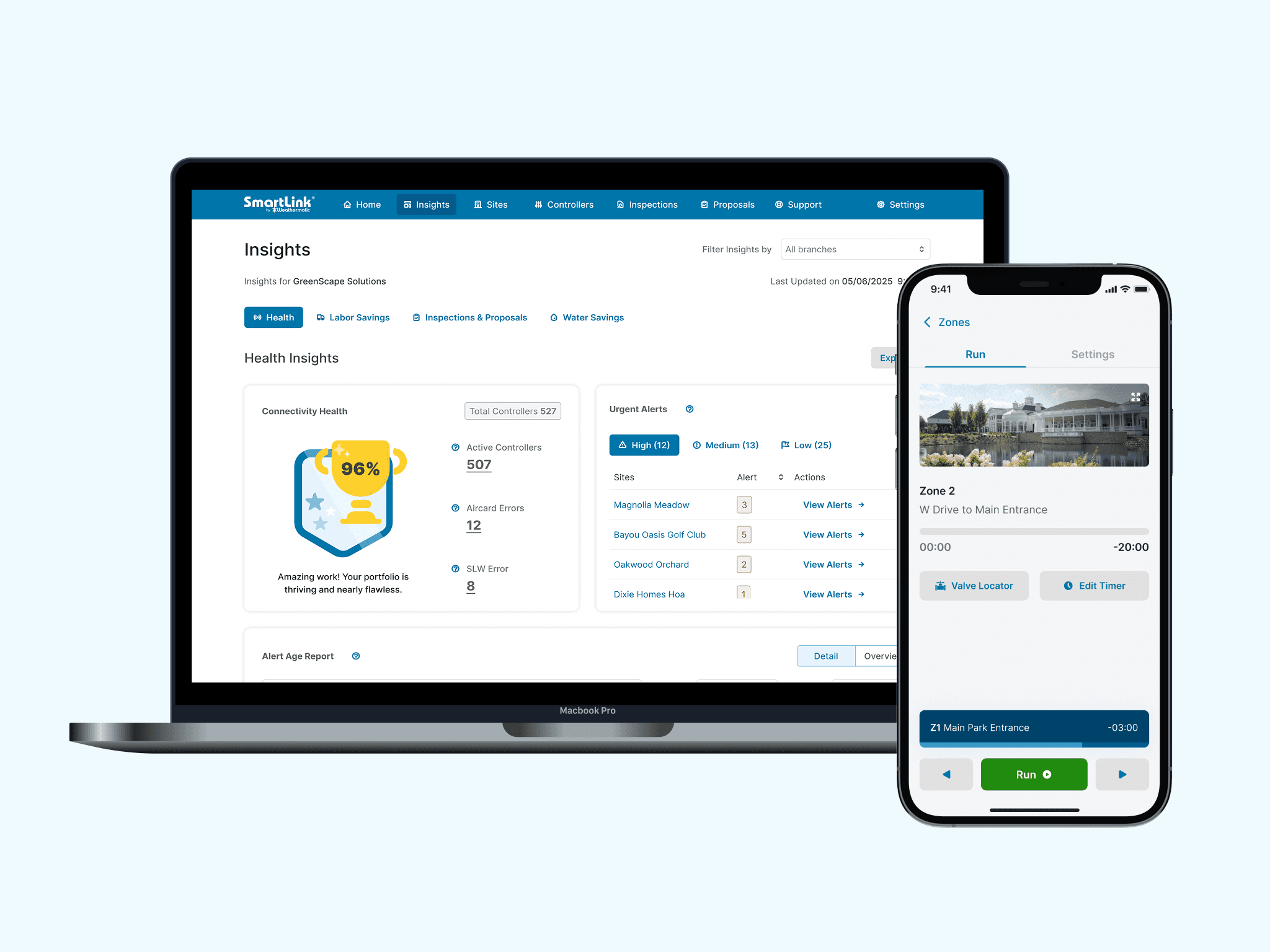
Landscape maintenance companies across the U.S. are facing rising operational costs, a shortage of qualified labor, and increasing liability related to water waste. SmartLink, a cloud-based irrigation management platform developed by Weathermatic, addresses these challenges by enabling remote control of irrigation systems and leveraging smart features that automatically adjust watering schedules based on real-time weather and site conditions.
While SmartLink had been functionally stable for several years, both the web and mobile experiences suffered from growing usability and scalability issues:
Complex workflows for core tasks—such as site inspections, proposal creation, and controller management—slowed daily operations and increased user frustration.
Web-first features poorly adapted for mobile use, creating friction for field-based users.
Unclear user segmentation, leading to misaligned feature prioritization across roles.
Inconsistent design patterns and layouts, making navigation unintuitive and reducing overall efficiency.
These challenges limited adoption of key features, increased reliance on manual processes and third-party tools, and ultimately reduced the perceived value of the platform.
My Role & Contribution
I joined SmartLink as a UX/UI Designer contractor in September 2022 and later transitioned into an in-house, solo Product Designer in June 2024. Throughout this period, I partnered closely with Product Managers, Front- and Back-End Engineers, and QA Engineers to design and deliver impactful, user-centered solutions.
My responsibilities spanned both strategic and executional design work, including:
End-to-end feature definition: collaborated with Product Managers and stakeholders to define high-impact user-facing features, leading the design process from research through feature-complete, high-fidelity solutions.
Design system foundations: built the foundations of a modular design system, including reusable components, design tokens, and documentation, to unify the experience across web and mobile products.
Workflow redesign: improved critical workflows such as Remote Controller Access, Inspections & Proposals, and Performance Reporting & Dashboard, based on user feedback and usage data.
High-fidelity design & prototyping: delivered 1000+ high-fidelity screens covering complex workflows, responsive breakpoints, variants, and edge cases.
Handoff & cross-functional collaboration: worked closely with front-end engineers using Figma and Storybook to ensure strong alignment between design intent and implementation.
Research & Insights
To deeply understand user needs and operational constraints, I led a mixed-methods research initiative that combined qualitative and quantitative approaches:
Virtual semi-structured interviews with irrigation managers, technicians/inspectors, and business owners to identify pain points and unmet needs.
In-person focus groups to gather feedback on existing features and validate early concepts.
In-app satisfaction surveys to capture real-time sentiment from active users.
On-site ride-alongs to observe technicians in real-world environments and understand physical, environmental, and time-based constraints.
Key Findings
This research surfaced several critical insights:
~80% of users primarily accessed SmartLink on mobile web while in the field, despite the existence of a mobile app. This behavior stemmed from workflows that were not optimized for mobile-first use.
~20% of users relied on desktop experiences, mainly to generate performance and efficiency reports for clients. Due to the lack of native reporting tools, many resorted to manual processes or third-party software.
Inconsistent UI patterns and complex interactions caused confusion—especially for first-time users—contributing to a low likelihood of recommending the product (average NPS: 6/10).
The findings were clear. SmartLink needed a streamlined, role-based experience—one that enabled fast, confident fieldwork while making performance, efficiency, and business outcomes easy to understand and communicate for office-based users.
Strategic Action Items
Before redesigning individual features, I focused on establishing the foundational elements required for long-term scalability and consistency.
Strategic Foundations
User personas & role clarity: led the definition of clear user personas, aligning motivations, needs, and usage contexts with business priorities and revenue impact. These personas became a shared reference across product, design, and engineering teams.
Unified design system: established a scalable Design Kit in Figma using variables and reusable components. In collaboration with engineering, I helped define a shared Storybook component library, improving consistency and accelerating development.
End-to-end design process: documented a standardized design process—from research and exploration to UX flows and validation—reducing inconsistencies and strengthening cross-functional collaboration.
Roadmap Alignment
With these foundations in place, I partnered with product leadership and stakeholders to define a prioritized roadmap focused on the most impactful and frequently used features:
Remote Controller Access
Inspection Tool
System Performance & Business Reporting
Results & Feature Outcomes
Remote Controller Access
Remote Controller Access is a core SmartLink subscription feature that allows users to manage irrigation controllers remotely, reducing field visits and manual adjustments.
Problem
The legacy experience introduced unnecessary friction due to:
Dense layouts and unintuitive navigation
Outdated visual design that obscured information hierarchy
Limited safeguards to prevent configuration errors, particularly for less experienced users
Solution & Outcome
I led a redesign focused on clarity, efficiency, and user confidence:
Clear information hierarchy and navigation, applying Gestalt principles to improve scannability and comprehension.
Bulk-editing workflows using interactive tables inspired by familiar spreadsheet patterns (e.g., Google Sheets, Excel), enabling faster configuration at scale.
Proactive error prevention, including real-time validation and contextual warnings based on irrigation standards and hardware constraints.
The result was a more intuitive and scalable experience that reduced errors and improved task completion speed.
Inspection Tool
The Inspection Tool enables users to identify system issues and generate reports during site visits. Although seasonal, it represents one of the largest revenue opportunities for customers by supporting upsells and system optimization.
Problem
The original experience lacked contextual awareness. Inspections are primarily conducted by field technicians on mobile devices, yet the feature had been designed for desktop use—slowing inspections during peak seasons.
Solution & Outcomes
By reframing the problem around real-world usage, I delivered a mobile-first redesign that:
Optimized for field conditions, accounting for bright sunlight, wet or gloved hands, and large multi-zone sites.
Reduced cognitive load through simplified layouts and progressive disclosure.
Delivered a responsive experience across phones and tablets, ensuring consistency regardless of device.
This redesign significantly improved usability during high-volume inspection periods.
Insights & Reports
Problem
SmartLink lacked native reporting tools that allowed different user roles to quickly understand system health, efficiency, and business impact.
Solution & Outcomes
I designed a new Insights feature offering three report types:
System Performance (Health Insights), for Irrigation Managers to identify inefficiencies and system risks.
Cost Savings (Water & Labor), for Property and Account Managers to validate financial and operational value.
Team Performance (Inspections & Proposals), for managers to assess team effectiveness and identify opportunities within the sales funnel.
This feature enabled:
Accurate, continuously updated data to support renewals, upsells, and new business conversations.
Outcome-focused performance discussions, shifting conversations from activity metrics to measurable results.
Cross-role alignment through a shared source of truth, reducing reliance on manual reporting and third-party tools.
Reflection
This project represented a shift from incremental UI improvements to platform-level product design maturity. As the solo product designer, I led stakeholder conversations to align on user roles, operational realities, and long-term goals, translating those inputs into cohesive, production-ready solutions. The work required balancing immediate usability needs with foundational investments that would support scale, consistency, and efficiency over time. The resulting designs helped move SmartLink toward a more structured, user-centered platform and continue to shape how I approach systems thinking, stakeholder alignment, and end-to-end product ownership in complex environments.
Other Projects
A curated selection of product and multimedia design work focused on real-world impact.